
By Constance Abad — Founder and director of Qwerty Travel
There is an idea that appears often when someone starts planning a major trip to South America. They think of the continent as a larger version of Europe: a place where you cross a border, visit a new city, try different food and keep moving. The reality goes much deeper than that.
Travelling South America is not simply about crossing borders. It means constantly shifting landscape, culture, rhythm and climate — and very often, your entire understanding of what it means to travel.
Twelve countries, nearly twice the surface area of Europe, a dozen living indigenous languages, ecosystems ranging from the Amazon rainforest to the Patagonian glaciers, from the Andean altiplano to the Atacama Desert and the Caribbean beaches of Colombia. After years of designing routes across the continent, one thing keeps repeating: travellers arrive expecting to discover new destinations. What they don’t expect is to find that each stage feels like it belongs to a different world.
When someone lands in Rio de Janeiro for the first time, the city makes an impact from the very first moment. With 6.2 million inhabitants and a geography that uniquely combines sea, mountain and urban jungle, Rio has an energy you feel from the airport taxi. The beaches are full from early morning. Life happens in the street. Music appears where you least expect it. It is a destination that invites you to go out, walk, mix in and take part.
A few days later, that same traveller may find themselves standing before Iguazú Falls. The contrast is hard to prepare for. 275 falls spread across a 2.7-kilometre front, dropping up to 82 metres. The sound arrives before the image does. Declared a UNESCO World Heritage Site in 1984, the falls system covers over 67,000 hectares of subtropical jungle. For hours there are no buildings, no avenues, no city noise. Nature completely dominates the experience.
The feeling is so different it is hard to believe both places belong to the same trip. And that is only the beginning of what the continent can offer. More than once we have heard exactly the same sentence at the end of a visit: “I wasn’t expecting this.” And they almost never mean the size of the falls. They mean the constant sound of the water, the humidity suspended in the air and the sensation that nature is entirely in control of the landscape.
One of the most fascinating things about the continent is the speed at which it transforms the traveller’s perception. In Buenos Aires, a city of more than 15 million people in its metropolitan area, the experience revolves around urban life: conversations stretch long over dinner, historic cafés are still full at eleven at night, the neighbourhoods have distinct identities you sense just by walking through them. It is not a destination you consume quickly. It is a place you discover gradually.
Then comes Patagonia. And there, exactly the opposite happens: cities step back and nature takes over entirely. Perito Moreno Glacier, one of the few glaciers in the world that is not retreating, advances between two and three metres a day and calves with a sound like distant thunder. Torres del Paine covers over 181,000 hectares of extreme landscape in Chilean Patagonia. In places like these, the best plan is simply to stop and look.
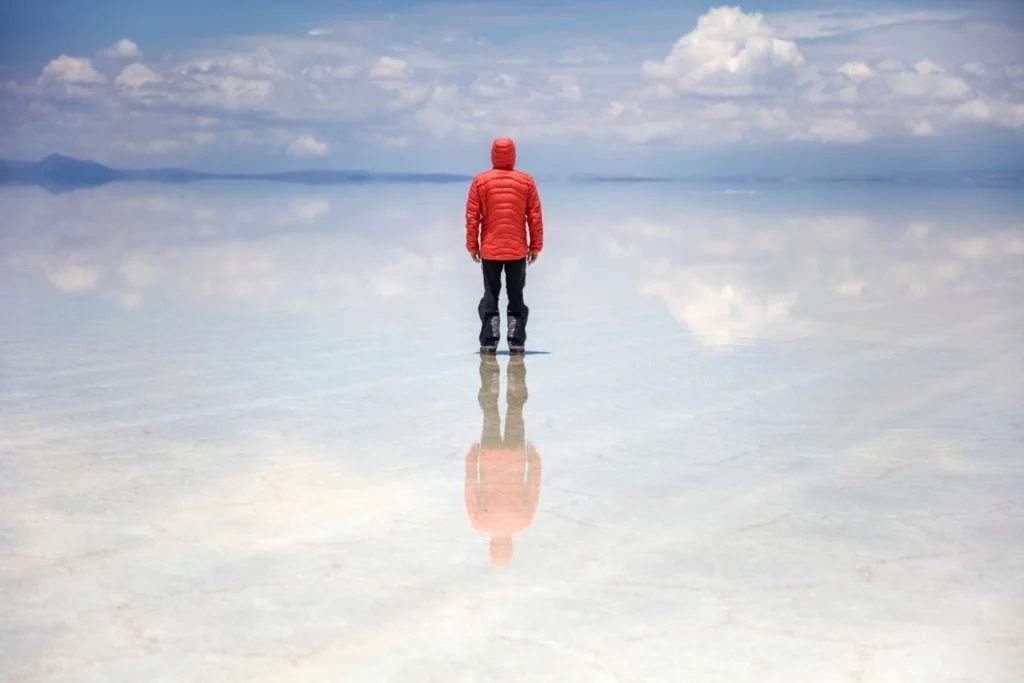
But scale also shifts in other ways. The Salar de Uyuni, in Bolivia, is the world’s largest salt flat: 10,582 km² at 3,656 metres altitude. A white mirror so flat that NASA uses it to calibrate satellite altimeters. During the rainy season, between January and April, the salar becomes a reflective surface that doubles the sky. It is not a landscape. It is a visual experience without any known frame of reference.
One of the most common mistakes when planning a South America trip is assuming that all destinations are approached the same way. Buenos Aires allows intense days. So does Rio. But Patagonia does not. Nor does the Sacred Valley. Nor much of the Peruvian Andes, where altitude — Cusco sits at 3,400 metres above sea level — directly shapes the rhythm of every day. Nor the Galápagos, where the logic of the visit is set by the ecosystem and the national park’s timetables, not by the traveller’s schedule.
Trying to maintain the same pace for three weeks typically produces the opposite of what was intended: the traveller arrives exhausted at precisely the places where they most need to slow down. That’s why we invest so much time building balanced itineraries. The success of a route does not depend only on the destinations chosen, but on how the rhythms alternate.
| Region | What defines the experience | What you should know |
|---|---|---|
| Rio de Janeiro | Urban energy, beaches and outdoor lifestyle | Home to 6.2 million people. A unique landscape where the sea, mountains and urban rainforest coexist within the same city. |
| Iguazú | Nature and monumental scale | 275 waterfalls stretching across 2.7 km, with drops of up to 82 metres. A UNESCO World Heritage Site since 1984. |
| Buenos Aires | Culture, gastronomy and local life | More than 15 million people live in its metropolitan area. Each neighbourhood has its own distinctive identity and atmosphere. |
| Santiago + Valparaíso | Urban transition and contrasting landscapes | The Andes are visible from Santiago on clear days. Valparaíso has been a UNESCO World Heritage Site since 2003. |
| Andean Peru | History, altitude and cultural heritage | Cusco sits at 3,400 m above sea level, while Machu Picchu stands at 2,430 m. UNESCO World Heritage Site since 1983 and one of the New Seven Wonders of the World since 2007. |
| Patagonia | Extraordinary landscapes, silence and wild nature | Torres del Paine protects more than 181,000 hectares. Perito Moreno Glacier is one of the few major glaciers in the world that remains in dynamic equilibrium. |
| Bolivia | High-altitude landscapes, Indigenous culture and extraordinary scenery | The Uyuni Salt Flat covers 10,582 km², making it the world's largest salt flat, at an altitude of 3,656 metres above sea level. |
| Ecuador & Galápagos | Unique biodiversity and pristine ecosystems | The Galápagos Islands became the world's first UNESCO Natural World Heritage Site in 1978 and are home to more than 2,000 endemic species. |
| Uruguay | Relaxed pace, Atlantic coastline and colonial heritage | Colonia del Sacramento has been a UNESCO World Heritage Site since 1995. Uruguay has one of the highest Human Development Index (HDI) rankings in South America. |
None of these experiences replaces the previous one. They accumulate. And that accumulation is precisely where much of the richness of the trip lies.
Argentina, Chile, Peru and Brazil account for the majority of first great trips across the continent — and for good reason: they offer a combination that is hard to match. But South America has a reach and a diversity that goes far beyond those four countries, and knowing this changes how you approach any route.
Ecuador offers one of the most extreme contrasts on the continent: the Galápagos Islands were the first Natural Heritage site ever designated by UNESCO, in 1978. The archipelago lies 972 kilometres off the Ecuadorian coast and is home to over 2,000 endemic species found nowhere else on the planet — marine iguanas, giant tortoises, penguins on the equator. It is a destination that requires dedicated time and its own internal logic, but one that is completely unlike anything else.
Bolivia brings the most radical dimension in terms of altitude and landscape. Beyond the Salar de Uyuni, La Paz — seat of government at over 3,600 metres above sea level — is a city that defies any familiar urban reference. The Bolivian altiplano has a living indigenous culture that is not museified: it is present in the markets, the clothing, the architecture and the way people relate to the land.
Uruguay offers something no other country on the continent provides in quite the same way: a genuinely unhurried pace. Montevideo and Colonia del Sacramento — the latter a UNESCO World Heritage Site since 1995 — have a human scale and an atmosphere that contrasts sharply with the major South American capitals. For certain traveller profiles, that counterpoint is exactly what the trip needs.
There is an instant we see repeat itself constantly. It doesn’t happen on the first day. It rarely happens in the first week. It usually appears after several shifts of scene: when the traveller has been through a major city, witnessed nature on a monumental scale and arrived somewhere with a different historical and cultural weight.
Then something changes. The traveller stops comparing destinations with each other. Stops asking which one they liked best. And begins to understand that each one responds to a completely different logic. Patagonia no longer competes with Rio. Cusco no longer competes with Buenos Aires. The Salar de Uyuni no longer competes with Cartagena. Each place starts to occupy its own rightful space, and the experience becomes much richer.
That is when the trip moves to another level. And when that shift happens, most travellers start thinking about coming back.
South America is often talked about as a continent spectacular for its nature. That’s true. But to reduce it to that would be to oversimplify. The cultural contrasts are equally fascinating, and often harder to anticipate.
Brazil has a social energy completely different from Argentina’s: more spontaneous, more physical, built around street life and music. Argentina has a different relationship with time — dinners start late, conversations are never rushed. Chile has its own relationship with the land and the mountains: the Andes are visible from the centre of Santiago on clear days. Peru retains an Andean presence that is still an active part of everyday life: languages, rituals, architecture and gastronomy that are not museum heritage but living culture.
Colombia has a blend of Caribbean heritage, Andean culture and ethnic diversity that makes it radically different from any other country on the continent. Bolivia has a relationship with the land and with altitude that changes your perception of your own body. That’s why South America is so hard to explain to someone who has never been there. It is not a homogeneous experience. It is a collection of distinct worlds connected by the same geography.
There are destinations you visit once. South America rarely belongs to that category. Not because the continent is vast, but because nobody manages to take it all in on a single trip.
A traveller can discover Patagonia and leave wanting to explore the Argentine northwest. Another can fall in love with Peru and return for Lake Titicaca or the Peruvian Amazon. Another can discover Brazil and realise they have barely seen a fraction of the country. Another can visit Colombia for the first time and understand they need more time for the Caribbean coast.
The most common feeling at the end of a major South America route is not that something has been completed. It’s that a door has been opened. First trips tend to define exactly the regions left unfinished for the next one.
If you’re thinking about a first major trip across the continent, you can see how we build one of our most complete routes on our South America in Full page.
If there is one conclusion that repeats itself constantly among our travellers, it is this: the best memories are rarely connected to the most famous places. They often appear where least expected: a conversation over dinner at a Patagonian estancia, a quiet morning on a Buenos Aires square, a sunset over the Sacred Valley, a walk without any hurry along Lake Nahuel Huapi, an afternoon in Cartagena after the other tourists have left. These moments are hard to plan. But they appear far more easily when the trip has the right pace.
What we try to build in every itinerary is not a collection of destinations. It’s a sequence of experiences that makes sense and allows the traveller to discover the enormous diversity of the continent without turning the journey into a logistical race.
I remember a family who started their trip in Rio de Janeiro convinced that the most striking moment would be Iguazú Falls. Two weeks later, finishing up in the Sacred Valley, they told us something different: that what had surprised them most was not any specific place, but the feeling of having lived several completely different trips within the same journey.
— Constance Abad, founder of Qwerty Travel
When we organise a multi-country South America trip, we don’t only think about which places to include. We think about how the trip will feel: we analyse the shifts in landscape, the rhythms, the distances, the altitude at each stage, the energy of each destination and the way each leg prepares the next. We work in Argentina, Chile, Peru, Brazil, Colombia, Bolivia, Ecuador and Uruguay, with local operators and guides in each country who allow us to design routes with first-hand information.
Travelling South America is not simply about moving. It’s about building a sequence of experiences that makes sense. When that happens, the continent stops feeling like a sum of countries and starts feeling like one of the most complete travel experiences there is.
Perhaps that’s why South America is so hard to explain to someone who hasn’t travelled it yet. Because it isn’t just a collection of countries. Nor a list of famous places. It is a succession of landscapes, cultures, rhythms and ways of understanding the world that constantly shift in front of you. And when the trip is well built, all those contrasts end up forming a coherent story that stays with you for years. That is exactly the story we try to build in every itinerary.
Constance Abad — Founder and director of Qwerty Travel
She has spent over fifteen years designing tailor-made itineraries across South America, working with local operators and guides in Argentina, Chile, Brazil, Peru, Bolivia and Ecuador. She has designed routes for over four hundred travellers from Europe, North America and Latin America, with very different profiles: couples, families, solo travellers and groups. She has personally travelled all the main destinations included in the routes she designs.
LinkedIn: linkedin.com/in/constance-abad
There is no universal answer, but experience shows that three to four countries allow a well-balanced experience in three weeks. The most common combination for a first trip includes Brazil, Argentina and Peru, with Chile as a fourth stage when time allows. Bolivia tends to appear on second trips, once the traveller has a reference point for the continent and can go deeper.
It depends on the time available. With less than two weeks, focusing on one country allows you to go deeper. From three weeks onwards, combining two or three countries is perfectly viable with a well-designed itinerary. The usual mistake is not combining countries, but trying to fit too many into too little time — which turns the trip into a succession of airports.
The density of contrasts within a single journey. No other continent allows you to go from a city of 15 million people to an active glacier, from subtropical jungle to archaeological sites at 3,400 metres, from a 10,582 km² salt flat to an archipelago with 2,000 endemic species — all within the same trip. That extreme diversity is what makes a South America journey so hard to compare with anything else.
Three weeks is the reasonable minimum to combine four or five main destinations without transfers dominating the calendar. With four weeks, the trip gains depth and room to breathe. Below two weeks, we recommend focusing on one or two countries. A trip that also wants to include Colombia, Bolivia or the Galápagos needs at least four weeks to do it properly.
It depends on the destinations included. As a general reference, April to October is the most favourable window for the Peruvian and Bolivian Andes — the dry season in Cusco, Machu Picchu and the Salar de Uyuni. Patagonia has its best window between November and March. The Galápagos can be visited year-round, though each season offers different conditions for wildlife. Uruguay works well almost any month. Each itinerary requires analysing the dates stage by stage, not as a whole.
If South America has been on your travel list for a while, this is the moment to turn it into a real itinerary. Every route starts with a conversation: what you want to see, when you’re travelling and at what pace. From there, we build the trip that makes sense for you.
First consultation, no commitment: we’ll tell you exactly what you will — and won’t — see based on your dates.
www.qwerty-travel.com · info@qwerty-travel.com